Longitude Zero, Wrist One: Why GMT Watches Speak to the British Collector
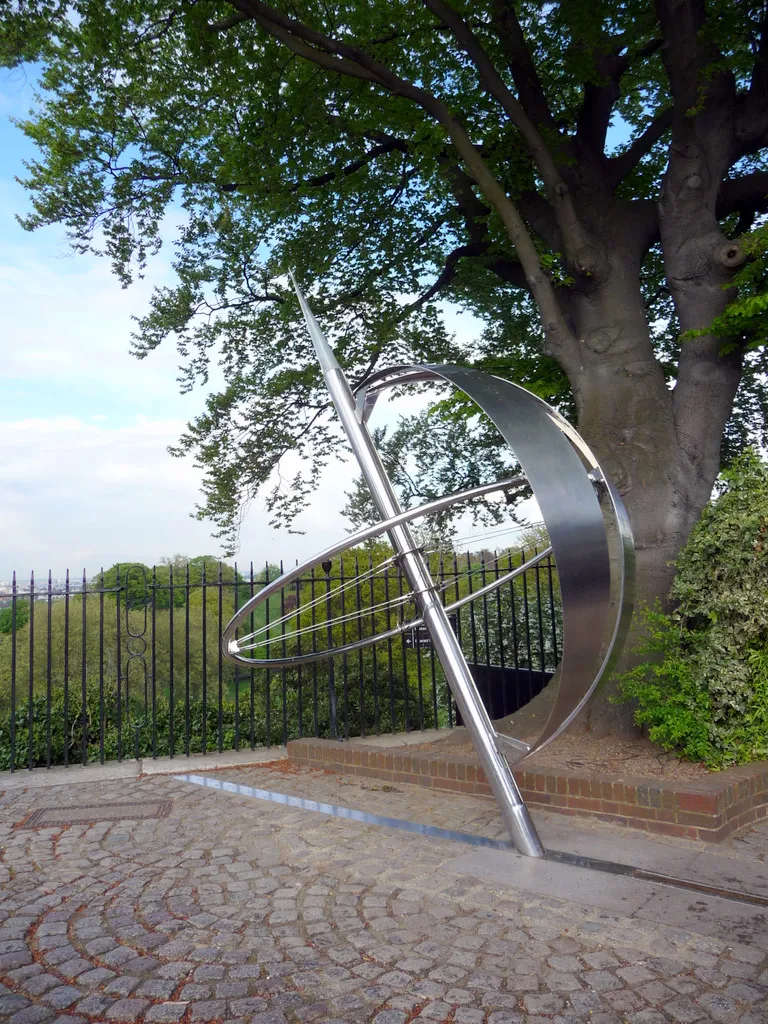
Photo: Christine Matthews , CC BY-SA 2.0, via Wikimedia Commons
There is a small brass strip in a courtyard in Greenwich that most tourists photograph and most watch collectors should study more carefully. The Prime Meridian Line, marked since 1884 as longitude zero, is the reason every hour on earth is measured against a reference point that happens to sit thirteen miles from central London. And yet, curiously, the complication most directly descended from that fact — the GMT watch — was born in Geneva, for an airline, and only later adopted with real enthusiasm by British buyers.
That irony is worth unpicking, because it explains something about how the modern UK collector relates to dual-time watches: not as a novelty borrowed from elsewhere, but as a quiet reclaiming of horological territory we historically owned.
The Reference Point We Gave Away
Before the 1884 International Meridian Conference, time was a local affair. Noon in Bristol arrived some ten minutes after noon in London, and nobody thought this strange. The railways forced standardisation first, and the conference formalised it second: Greenwich Mean Time became the world's baseline, with all other zones expressed as offsets from our line.
The second hand of every GMT watch on sale today is, in a sense, set against a British coordinate. When a pilot in Singapore adjusts a local-hour hand, she is moving it relative to a zero point fixed in south-east London. Collectors who find romance in this are not being sentimental — they are responding to the genuine architecture of the time system.
What Britain gave away was the mechanism. The jet age, not the empire, produced the practical dual-time wristwatch, and the archetype that dominates the category was conceived for intercontinental crews, not for anyone standing on the meridian line. It took decades for British buyers to see the GMT not as an American aviator's tool but as something closer to home.
Why the Complication Resonates Here
There are practical reasons, of course. Britain's diaspora is vast: families in Sydney, Toronto, Lagos, Hong Kong. A country of emigrants and frequent travellers has an obvious use for a watch that holds home time while displaying local time. The classic GMT configuration — a dedicated hand tracking the reference zone, a main hour hand set to wherever you stand — maps almost poetically onto the expatriate experience. Local time on the dial; home time in the hand.
But there is something else at work, less easily quantified. The UK collector has watched the centre of commercial horology shift decisively eastward and westward, to Geneva and Shenzhen and the auction rooms of New York. The GMT complication is one of the few places where the reference point — literal, geographic, unarguable — remains British. Owning one is a small assertion that the world's time still passes through Greenwich, whatever the market is doing.
Reading Zero Degrees on the Dial
Manufacturers understand this, and a discerning buyer can spot the homage. Some references are explicit: limited editions engraved with meridian coordinates, or dials marked with the longitude figure itself. Others are subtler — a 24-hour scale rendered in a serif typeface that nods to railway chronometry, or a bezel split into two twelve-hour halves in reference to the old astronomical day.
The typography is often where the meaning lives. A GMT hand finished in a deep green, or a dial referencing the observatory dome itself, signals an awareness of lineage that goes beyond the tool-watch cliché. Conversely, the collector should be wary of the meridian used as mere decoration — a brass line stamped on a caseback tells you nothing about whether the movement's 24-hour mechanism is genuinely independent of the main gear train.
When evaluating a dual-time piece, three questions matter. Is the local hour hand settable independently, in hour jumps, without disturbing the minutes or seconds? Is the 24-hour indication legible at a glance, day and night? And does the design treat the second time zone as a function rather than a logo? A watch that answers all three is honouring the complication. One that answers none is merely borrowing a British idea to sell a Swiss product — which, historically, is at least a fitting arrangement.
A Complication Worth the Sentiment
It would be easy to dismiss all of this as marketing dressed in astronomy. The GMT does not make a watch more accurate, and the majority of British buyers will spend most of their lives within a single time zone. But horology has never traded purely in utility. The dual-time watch, worn in Britain, is one of the few complications that connects the object on the wrist to the system that governs every other clock in the world — and that system begins in a courtyard in Greenwich.
Longitude zero is a coordinate. Worn well, it is also a point of view.