Motion and Ornament: Is the Watch Winder a Machine, a Sculpture, or a Very Expensive Argument?
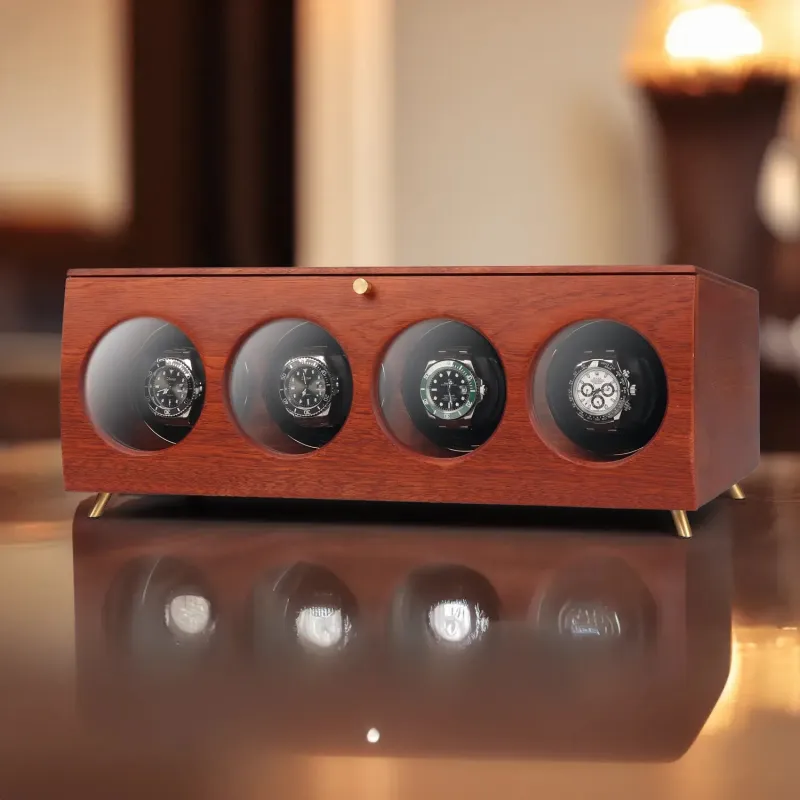
Photo: luxury wooden watch winder cabinet on desk interior, via driklux.com
Few accessories in horology provoke such immediate division as the watch winder. To its advocates, it is a matter of care: a mechanical watch, left unwinding, stops; a stopped watch must be reset, its date wound through, its complications coaxed back to life. To its detractors, it is a solution in search of a problem — a motorised plinth that keeps a movement running for no reason other than the owner's impatience.
Both positions deserve a hearing, not least because the winder has lately undergone a transformation that changes the terms of the debate entirely. It is no longer merely equipment. It is furniture.
The Practical Case, Stated Fairly
A modern watch with a quickset date takes seconds to reset. The genuine argument for winding lies elsewhere: in perpetual calendars, moonphases, and annual calendars whose correction procedures are fiddly, model-specific, and in some cases require a watchmaker's intervention if done incorrectly. For the collector who rotates between such pieces, a winder spares both frustration and risk.
Then there is the lubrication argument, endlessly contested. A running movement circulates its oils; a dormant one does not. Sceptical watchmakers counter that modern lubricants are stable for years and that a movement resting is a movement wearing nothing. The honest answer is that neither camp has conclusive evidence, and the mechanical risk of a quality winder used correctly is, at worst, negligible.
The strongest case, in truth, is behavioural. A watch that is always set and always running is a watch that gets worn — and a watch that gets worn justifies itself.
The Sceptic's Rebuttal
A master watchmaker we spoke to in a Birmingham workshop was blunt. "A winder adds wear cycles to a movement for no functional benefit in ninety per cent of cases. People buy them because a stopped watch makes them anxious. The watch doesn't care."
His advice: wind manually, wear in rotation, and spend the winder's cost on a service fund. It is a position of rigour, and for the single-watch owner, it is probably correct.
The Furniture Argument
And yet the market has moved on. The contemporary winder — German-engineered, Swiss-finished, or increasingly built by British cabinetmakers working in fumed oak and brass — is designed to be seen. Single units in solid walnut sit on desks like small sculptures; multi-watch cabinets with glass fronts and silent motors have become centrepieces of the converted-study and the dressing room.
One Yorkshire cabinetmaker, whose waiting list now runs to eight months, put it plainly: "Nobody commissions a four-watch winder because they can't be bothered to set a date. They commission it because the thing is beautiful and it moves. It's a kinetic object in a room full of still ones."
This is the winder's real modern identity: part mechanism, part ornament, part declaration. Whether that declaration is worth making is a matter of taste, not horology.
A Pragmatic Buying Guide
For those persuaded — or at least tempted — a few principles will prevent expensive regret.
Buy quiet above all else. A winder lives in domestic space, and a motor heard at night is a motor regretted. Reputable makers specify decibel levels; anything audible from an armchair is too loud.
Match turns per day to your movement. Most modern calibres need between 650 and 1,100 turns daily, rotating in specific directions. A quality winder offers programmable settings; a cheap one offers none, and guesswork is how movements are stressed.
Prioritise build over branding. Solid timber, felt-lined cushions that grip without pressure, and a stable power supply matter more than a name on the glass.
Size honestly. A winder for two watches should hold two watches — not six empty cushions awaiting a collection that may never arrive.
The Verdict
Is the winder necessary? Almost never. Is it defensible? Increasingly, as an object of design and a tool for the genuinely complicated collection, yes. Buy one as a machine and you may be disappointed. Buy one as the study's quiet centrepiece — turning slowly, silently, in the corner of the room — and you will likely wonder how you managed without the theatre of it.