Pushers, Crowns and the Poetry of Elapsed Time
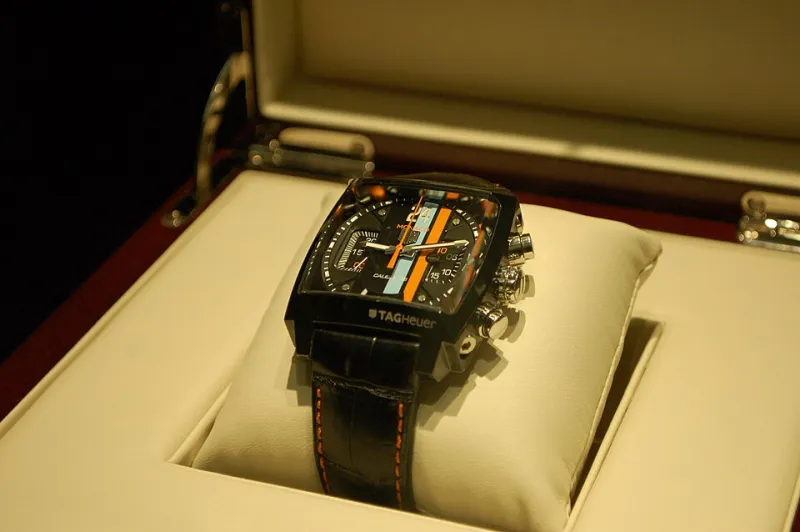
Photo: Ferengi, CC BY-SA 3.0, via Wikimedia Commons
There is a particular pleasure in operating a chronograph that no other complication quite replicates. The firm click of a pusher, the sweep of a hand set in motion, the satisfaction of returning everything to nought — it is horology as interaction, a mechanical dialogue between wrist and wearer. It is little wonder that the chronograph remains, for so many British collectors, the complication against which all others are judged.
A Complication Born of Competition
The chronograph's origins are rooted firmly in sport. In the early 1800s, King George IV commissioned a device capable of timing the final moments of a horse race from the royal box at Newmarket — a fittingly British genesis for a complication that would come to define precision under pressure. Through the following century, inventors on both sides of the Channel refined the idea, culminating in the column-wheel mechanisms and twin-pushers we recognise today.
By the 1930s, the chronograph had found a second home in the air. Aviators required legibility, reliability and the ability to record intervals at a glance, and the resulting 'pilot' chronographs — with their oversized dials and luminous numerals — remain among the most collected designs of the twentieth century. When the jet age arrived and motoring's golden era ran in parallel, the chronograph was there, strapped to dashboards and wrists alike.
Under the Dial: What Makes a Chronograph Tick
Mechanically, a chronograph is a stopwatch grafted onto a conventional timekeeping movement — a marriage of two escapements' worth of ambition. The architecture matters. A column-wheel mechanism, in which a rotating pillar governs the start, stop and reset functions, offers the smoothest engagement and is prized by purists. The alternative, a cam-lever system, is more economical to produce and, in capable hands, every bit as durable.
Then there is the question of integration. Some chronographs are modular — a stopwatch module bolted atop a base calibre — while others are true in-house designs conceived as a single entity. The latter approach, exemplified by the great manufactures of the Vallée de Joux and increasingly by British and independent ateliers, typically yields a slimmer profile and a more harmonious action. Neither is inherently superior; both can be excellent. But knowing which sits beneath the dial is part of knowing the watch.
Why Collectors Keep Coming Back
The chronograph occupies a curious position: genuinely useful in origin, yet rarely used for its intended purpose today. Its appeal is not utility but narrative. A chronograph dial is a small theatre of subdials, tachymeter scales and layered information — a composition that rewards long looks. It is also a complication with stories attached: the racetrack, the cockpit, the expedition.
For the UK buyer, there is an additional practicality. A well-chosen chronograph is a versatile companion — smart enough beneath a cuff in the City, robust enough for a weekend in the Cairngorms. Few complications transition so effortlessly.
A Buyer's Guide: Entry Points Worth Considering
For those contemplating a first chronograph, the current market is unusually generous. Several paths merit attention:
-
The heritage-flavoured mechanical (circa £1,500–£4,000): A growing roster of brands offer column-wheel-inspired movements with sapphire casebacks, allowing the owner to appreciate the architecture. Look for a well-balanced dial — subdials at three, six and nine o'clock remain the classic arrangement.
-
The hand-wound purist's choice (circa £3,000–£6,000): Manual-wind chronographs, often bi-compax in layout, offer slimmer cases and a more direct connection to the machine. Winding a chronograph by hand each morning is a ritual many collectors come to cherish.
-
The pre-owned modern classic: The secondary market rewards patience. Recent-generation chronographs from the established Swiss houses, serviced and with papers, frequently represent better value than their new equivalents.
Whatever route you choose, prioritise legibility, a comfortable case diameter for your wrist, and a movement whose finishing you can admire. A chronograph is a watch you will look at often; make sure there is something worth seeing.
Time, Measured Twice
The chronograph endures because it asks something of its wearer. It invites engagement, rewards curiosity and carries nearly two centuries of sporting and aeronautical romance on its dial. For the collector seeking a complication with both intellect and emotion behind it, the pusher-crowned chronograph remains, quite simply, the one to beat.