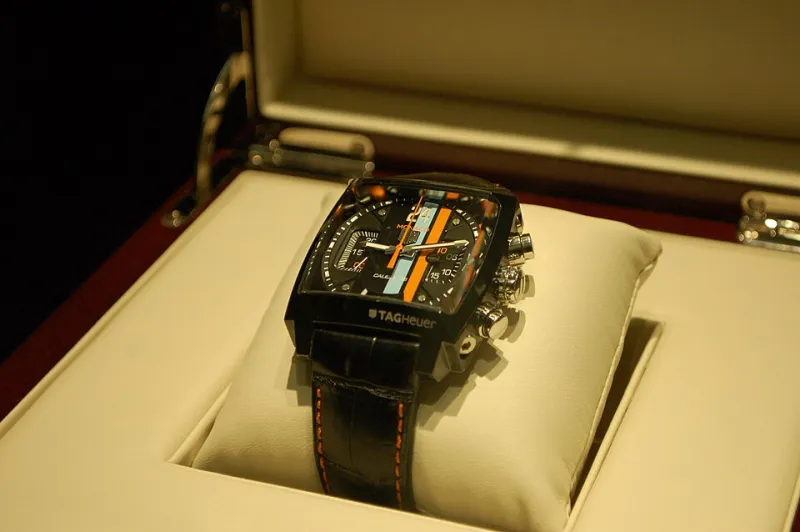
Luminous Hours: How Britain's Earliest Sunsets Reveal the True Test of a Dial

Photo: amh1988, CC0, via Wikimedia Commons
There is a moment, somewhere around four o'clock on a December afternoon, when the British commuter glances down at their wrist and sees nothing at all. The dial that looked so assured on the morning platform has vanished into the gloom of the Northern line. It is in these weeks — between the equinox's early slide into darkness and the slow climb back towards the solstice — that a watch's luminous work ceases to be a technical footnote and becomes the very point of the object.
A Glow Born of Necessity
Luminosity was never a luxury flourish. It was a demand of profession and war. The pilots of the 1930s needed to read their instruments in unlit cockpits; the divers of the Mediterranean and the North Sea needed legibility fathoms down. The first solution was radium-based paint, applied in factories whose workers — the Radium Girls, whose suffering is now one of horology's starkest cautionary tales — were instructed to point their brushes with their lips.
Vintage radium dials possess an undeniable romance, and an equally undeniable hazard. Collectors drawn to a 1940s Officer's watch with patinated, coffee-toned numerals should do so with eyes open: an intact radium dial emits measurable radiation, and a damaged one can release radon. Reputable UK dealers will disclose this; auction catalogues increasingly do. Admire the aesthetic, certainly — but handle with knowledge.
Tritium succeeded radium, safer yet still radioactive, its glow fading on a half-life schedule that gives vintage pieces their characteristic, faintly melancholic patina. Then came the modern era: photoluminescent compounds that store light and release it slowly, requiring no radioactive material at all.
The Super-LumiNova Age
Today's dominant compound, Super-LumiNova, is a strontium aluminate ceramic — a material that charges in daylight and glows for hours. Its performance is measured in grades and colours, and its application has become a genuine arena of brand differentiation. Some houses apply it thinly, as a discreet nod to legibility. Others, particularly in the dive and pilot traditions, treat it as a canvas: full-lume dials, sandwich constructions, and bezels that seem to float in the dark.
The science is simple enough. Larger surface area and greater thickness mean longer, brighter emission. The art lies in restraint — a dial that blazes like a novelty toy in a darkened restaurant does its wearer no favours. The finest modern lume is the kind you notice only when you need it.
A Shortlist for the Dark Season
For those whose winter commute will put their lume to the test, a few categories deserve consideration.
The Dive Watch remains the benchmark. A well-executed dive bezel with a luminous pip at twelve offers instant orientation in near-total darkness. British waters may not demand it, but the November 4.30pm twilight does.
The Pilot's Watch brings heritage to the argument. The luminous triangle and numerals of the classic Flieger layout were designed for cockpit legibility and translate beautifully to the 6.15am departure gate.
The Field Watch offers the most honest expression of the craft — simple sandwich dials, generous lume plots, and a design philosophy that has barely changed since the mid-century.
The Dress Watch with Discretion is the connoisseur's counterpoint: a piece whose hands carry just enough luminous material to be found in a darkened taxi without announcing themselves across the dinner table.
Darkness as the Final Examination
There is a pleasing inversion in all of this. We choose watches for how they look in light — the finishing, the dial texture, the interplay of brushed and polished surfaces. But a dial's true examination happens after sunset, when all that craft is reduced to points and lines of borrowed light.
This December, when the streetlights come on before you've left the office, take a moment in the stairwell. Cover your watch face briefly, then look. What glows back — steady, legible, quietly confident — is the part of the watch that was made for exactly this moment. The darkest weeks of the British year are not the season's compromise. They are its stage.